
2026-90-22 · Nathan Lyon
How To Check Crawl Space Humidity Levels In Older Clark County Homes
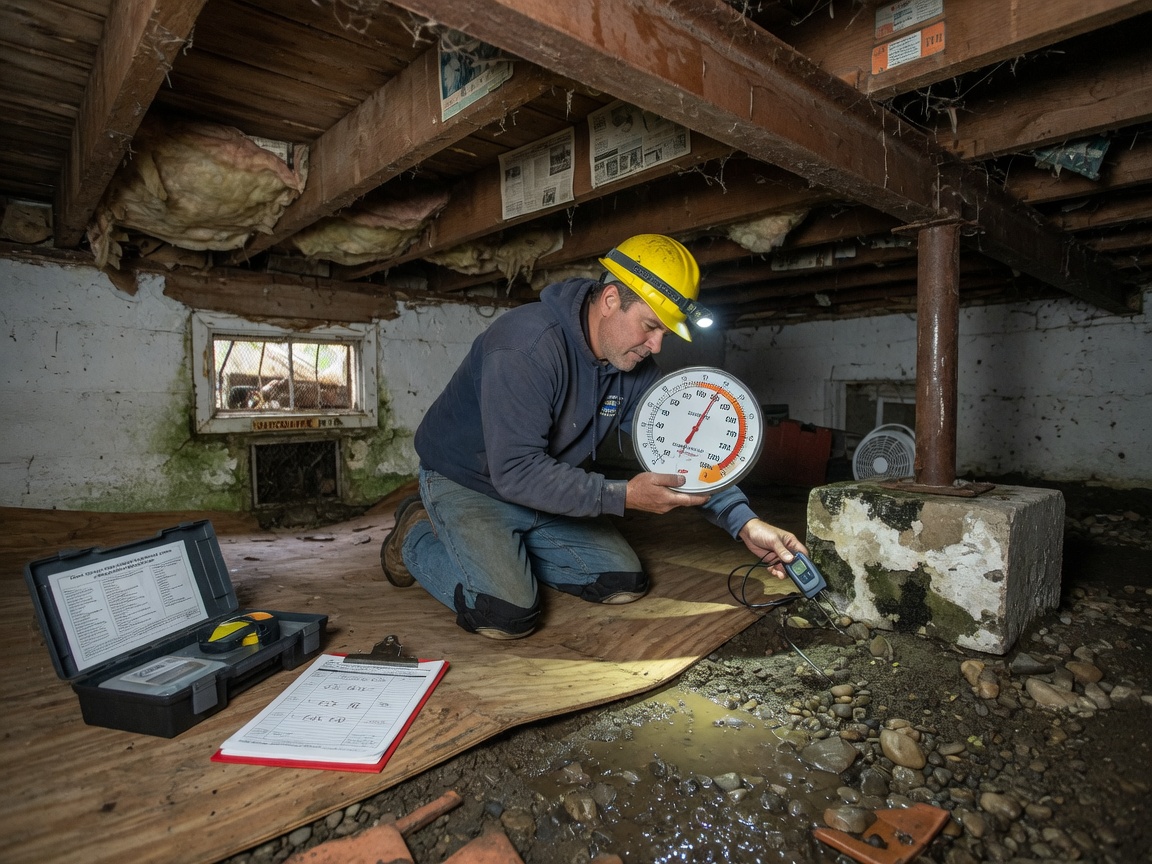
A damp crawl space rarely announces itself. The first signs are often a musty smell in the house, cold floors or sagging insulation, and by then the moisture has been building for a while. The good news is that you can measure it yourself with a cheap tool. This guide shows you how to check the humidity in a crawl space, how to read the numbers, and what to do depending on what you find. It is written for older homes in Vancouver and across Clark County, where cool, wet winters and warm, dry summers make crawl space moisture a seasonal pattern.
The short answer: place a small digital hygrometer in the crawl space, leave it for a few days, and read the relative humidity. Readings that stay above about 60 percent, especially in warm weather, suggest moisture that can support mold and damp framing. Combine the reading with a look at the soil, the insulation and the wood, because humidity alone does not tell you where the moisture is coming from.
Why humidity in the crawl space matters
Air from the crawl space moves up into the house through gaps in the floor, so a damp crawl space can mean a damp, musty house. Prolonged moisture can lead to mold, damp or fallen insulation, and over time rot in floor framing. Vancouver gets roughly 42 inches of rain in an average year, mostly from late fall through winter, so the soil under and around a house can stay wet for months.
What you need
- A digital hygrometer that shows relative humidity and temperature, ideally one that records minimum and maximum readings. These are inexpensive and sold at hardware stores.
- A flashlight and a camera or phone
- Gloves, long sleeves and a mask to protect against dust and mold
- A moisture meter for wood, if you want to check the framing directly (optional)
Safety first
- Do not enter if there is standing water near electrical wiring, outlets or equipment. Turn off power at the source if you are unsure, or call a professional.
- Watch for sharp objects, loose insulation, pests and low clearance.
- Never go in alone if the space is tight.
- If you see heavy mold growth, sewage or a strong chemical smell, stop and get help.
Step by step: measuring humidity
- Choose the right time. Check after a stretch of rain, and again in warmer, drier weather, because the cause of humidity changes with the seasons.
- Place the hygrometer about halfway into the crawl space, a few inches above the ground. Away from the vents is best, because vents can skew the reading.
- Leave it for 24 to 72 hours and then read both the current and the highest reading.
- Compare with outside. If the crawl space is much more humid than the air outdoors, the moisture is likely coming from the ground or from leaks, not from the weather.
- Repeat in another season, so you can see the pattern.
How to read the numbers
These are common rules of thumb, not strict limits, but they are useful:
- Below about 50 to 55 percent: generally comfortable and low risk for mold
- About 55 to 60 percent: borderline. Watch it, especially if it climbs in the warm months
- Above about 60 percent for long periods: mold and damp framing become more likely, and action is worth considering
- Above about 70 percent, or condensation on surfaces: a clear problem
Wood moisture is also useful. A common rule of thumb is that framing that stays above roughly 20 percent moisture content is staying wet enough to encourage mold, and that lasting higher readings put wood at risk of decay.
Look for the cause, not just the number
Humidity tells you how much moisture is in the air. These checks tell you where it comes from:
- The ground: is the soil wet, damp or covered? Bare soil releases humidity all year. A heavy polyethylene ground cover sealed to the walls and piers is the usual way to control it.
- Standing water: look for pooling after rain. If water collects, it needs drainage, because a liner over standing water does not solve the problem.
- The walls: wet patches, stains or white mineral deposits on foundation walls show water coming through.
- The vents: in a vented crawl space, warm, humid air coming in through the vents can condense on cold framing, ducts and pipes, according to Washington State University guidance.
- Plumbing: check pipes and drains for leaks, which can mimic a drainage problem.
- Outside the house: gutters, downspouts and grading that send water toward the foundation.
What to do based on what you find
- Humidity is fine and the soil is dry: keep monitoring. Make sure gutters and downspouts work, and check again after the next wet spell.
- Bare soil and high humidity: a sealed ground cover and moisture control. See crawl space waterproofing.
- Standing water or wet walls: drainage, and usually a sump, plus outside corrections. See exterior drainage and sump pump installation.
- Water entering through cracks: sealing and drainage. See foundation waterproofing.
- Wet or fallen insulation, mold or rotted wood: the moisture source needs fixing first, and the damaged materials are then replaced.
Common confusion, cleared up
Should a crawl space be vented or sealed? It depends. Traditional vents can work in a climate with less humid summers than the Southeast, but they can also bring in warm, humid air that condenses on cold surfaces. A sealed, conditioned crawl space controls moisture more directly. The best choice depends on the house, the water situation and local building rules.
Is plastic on the ground enough? Only if humidity from the soil is the main issue. If water pools or enters through the walls, a liner alone does not fix it, and water can collect on top of the plastic.
Will a dehumidifier solve it? It helps control humidity once the space is sealed, but it does not stop water coming in.
Do I need to fix it if I cannot smell anything? Often yes. You can have high humidity and damp framing before any smell appears.
Can I do all of this myself? You can measure and observe. Fixing the cause, especially drainage and sealing, is usually work for a professional.
When to get help
Call if humidity stays above about 60 percent, if water collects under the house, if insulation is wet, or if you see mold or soft wood. We inspect the crawl space, find where the moisture is coming from and explain the options before any work begins.
We work in Hazel Dell, Orchards, Felida, Uptown Village and Downtown Vancouver. Contact us to describe what you found.