
2026-10-26 · Nathan Lyon
Soil, Groundwater And Drainage Near The Columbia River: What It Means For Your Foundation
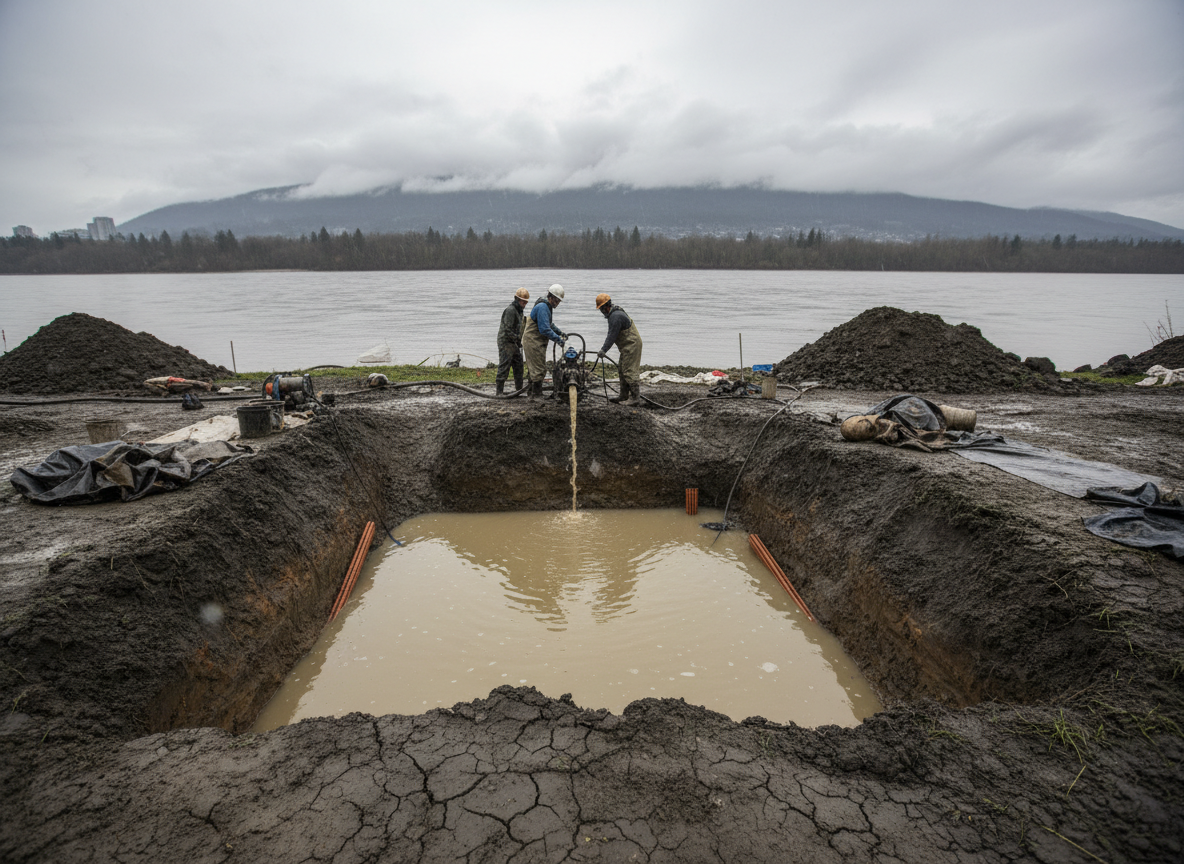
If you live near the Columbia River, you have probably heard that the soil and the water table are behind damp basements and crawl spaces. That is partly true, but it is not the same on every lot. This guide explains in plain terms how soil, groundwater and drainage work around a foundation, what is specific to the Vancouver area, how to find out what applies to your property, and what to do about it.
The short answer: water problems around a foundation come from three things: how much water arrives (rain and runoff), how fast the ground lets it drain away (soil), and how high the water sits underground (groundwater). In Vancouver, heavy winter rain is the constant. The soil and groundwater vary from lot to lot, which is why a fix that works on one street may not suit the next.
Rain: the constant
Vancouver has cool, wet winters and warm, dry summers, with roughly 42 inches of rain in an average year, most of it from late fall through winter. July and August are the driest months. That means the soil around a house can stay saturated for weeks or months, then dry out in summer.
Soil: how fast water drains
The soil under and around a house decides how quickly water soaks away:
- Clay and fine silt hold water and drain slowly, so rain can sit near the foundation
- Sandy and gravelly soil drains faster
- Mixed soils and fill vary, and are common where land has been graded for development
Soils in Clark County are not uniform. The Natural Resources Conservation Service groups them into eight major soil associations, including floodplain soils in bottomlands and different soils on terraces, uplands and foothills. Two lots a few blocks apart can drain very differently.
Groundwater and the river
Under the Columbia River floodplain around Vancouver, Camas and Washougal lies a major alluvial aquifer, which is partly recharged by water seeping in from the river, according to a US Geological Survey study. For a home close to the river or on low ground, that can mean groundwater sits closer to the surface than it does at higher elevations. In a wet season, a high water table can push water against basement walls and up through floors, which is called hydrostatic pressure.
The river also matters in another way. Waterproofing is not flood protection. If your property is in a mapped flood zone, flood rules apply separately, and you can check your flood zone with the Federal Emergency Management Agency flood maps.
How to find out what applies to your lot
- Look at the pattern: does water appear only after big storms, or does it persist in dry weather? Storm-only water points to surface runoff. Water that keeps coming in during dry weather points to groundwater or a leak.
- Look at the yard: soggy spots, moss, pooling water and slow-draining lawn suggest poor drainage.
- Use the free soil survey: the NRCS Web Soil Survey lets you look up the mapped soil type for your address, including drainage class.
- Check flood maps: FEMA flood maps show whether your lot is in a flood zone.
- Ask us to look: an inspection checks the grading, gutters, foundation and any sump, and finds where the water is actually coming from.
What to do about it
The fix depends on the cause:
- Too much surface water: exterior drainage systems, meaning grading, gutters, downspout extensions and French drains, move water away from the foundation
- Slow-draining soil that holds water against the wall: drainage outside, plus interior waterproofing to collect whatever still gets through
- High groundwater: a drainage system and a sump pump to remove the water that collects
- Damp crawl space: crawl space waterproofing with drainage and a sealed ground cover
- A wet basement: basement waterproofing, chosen to match the source of the water
- Leaking cracks: foundation waterproofing
Common confusion, cleared up
Is clay always the problem? No. Clay drains slowly, but plenty of damp homes have other causes, like downspouts that empty next to the wall or groundwater. Soil is one factor among several.
Does living near the river mean I will have a wet basement? Not necessarily. It can raise the odds of high groundwater, but many homes near the river are dry, and many homes far from it are damp. The pattern at your house tells you more.
Can waterproofing stop a flood? No. Waterproofing manages water seeping through and around the foundation. Flooding from a river or heavy storm is a separate matter.
Will fixing drainage outside be enough? Sometimes. If water only appears after storms, outside drainage is often the whole answer. If water keeps coming in during dry weather, you probably also need interior drainage and a pump.
Is a sump pump the same as waterproofing? A pump removes water that has collected. Waterproofing is the whole plan for keeping water out or carrying it away, and a pump is one part of it.
Next steps
If you are not sure what is behind your damp basement or crawl space, an inspection will tell you. We look at the grading, gutters, foundation and any sump, find the source and explain the options before any work begins.
We work in Hazel Dell, Orchards, Felida, Uptown Village and Downtown Vancouver. Contact us to arrange a visit.